
What would it feel like to be eight years old, standing on a ship in a foreign country, watching the shoreline disappear and not knowing where you would be sent next?
For Renate (Ronnie) Breslow, this was not a story from a history book. It was her life.
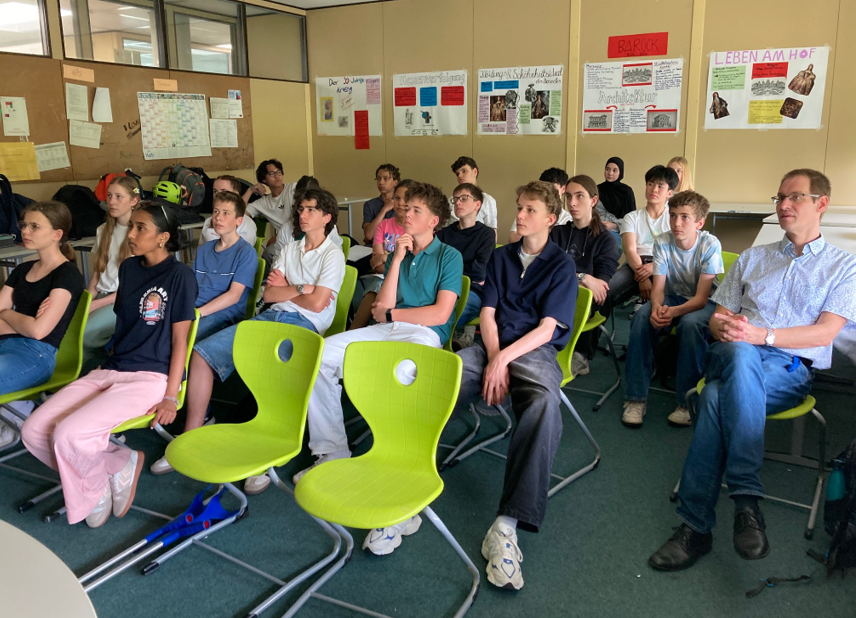
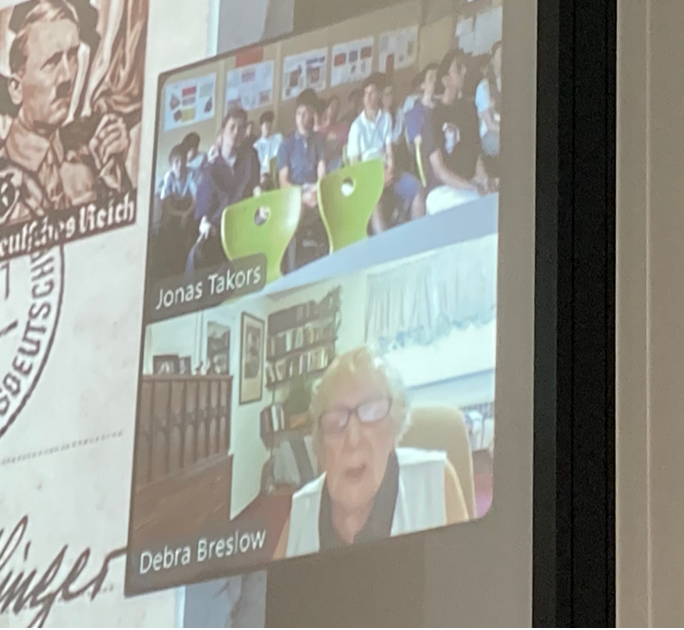
On May 21, 2026 our class had the opportunity to speak with 96-year-old !!!! Mrs. Breslow over a video call. Although she now lives near Philadelphia, USA, she grew up in Kirchheim and experienced the rise of Nazi Germany as a child. Through her memories, we learned how hatred, discrimination, and war affected one young girl and her family.
Mrs. Breslow described her early childhood in Kirchheim as happy and ordinary. She attended kindergarten and school, celebrated local traditions such as Fastnacht, and lived with her parents and her beloved nanny, Sophie. However, after Adolf Hitler came to power, life began to change. Nazi parades became common in Kirchheim, and anti-Jewish laws gradually took away the rights of Jewish citizens.
One of the first losses she experienced was the sudden departure of Sophie. Because Sophie was not Jewish, she was no longer allowed to work in a Jewish household under the Nuremberg Laws. Mrs. Breslow never got the chance to say goodbye and Sophie left without explaining herself to little Renate. Years later, Sophie sent a letter to the family, but by then they had already lost touch. During our conversation, Mrs. Breslow explained how painful that separation had been and how much she missed her childhood friend.
Her parents owned a business in Kirchheim. As anti-Jewish policies became stricter, Nazi guards stood outside the store, discouraging customers from entering. Eventually, the business was forced to close.
The hardest loss for Mrs. Breslow, however, was being excluded from school. She loved learning and was the only Jewish child in her class. One day, her teacher told her cold-heartedly not to return. Beyond school, she also lost many of her friends. Her best friend, Marianne, stopped playing with her after being punished by her father for associating with a Jewish child. Looking back, Mrs. Breslow told us that being isolated and suddenly treated differently was one of the most traumatic parts of her childhood.
After Reichspogromnacht, life became even more dangerous. Her father managed to obtain permission to travel to Cuba, but he was forced to sell the family home before leaving. Later, Mrs. Breslow and her mother received tickets to join him.
In 1939, they boarded the St. Louis, a ship carrying hundreds of Jewish refugees seeking safety. At only eight years old, Mrs. Breslow was excited by the voyage because she believed she would soon be reunited with her father. The ship even had games, toys, and a swimming pool. However, when the St. Louis arrived in Cuba, most of the passengers were not allowed to disembark. Despite the efforts of Captain Gustav Schröder, who tried to convince other countries to accept the refugees, the ship was forced to leave.
As the coastline disappeared, panic spread among the passengers. Many cried because they did not know where they would end up. Mrs. Breslow remembered feeling confused and frightened as the ship passed the coast of Miami while her father remained behind.
Eventually, the St. Louis returned to Europe. Mrs. Breslow and her mother were sent to the Netherlands, where they were placed in a detention camp and separated from each other.
Meanwhile, her father had legally reached the United States and worked tirelessly to bring his family there. During our discussion, Mrs. Breslow spoke about the kindness of a Dutch camp commander who helped her mother obtain permission to leave. At a time when many people turned away refugees, his actions helped save their lives.
Finally, Mrs. Breslow and her mother were able to travel to America. When they arrived in New York Harbor and she learned she would finally see her father again, she could hardly believe it. After years of uncertainty and separation, the family was reunited.
During the discussion, students asked Mrs. Breslow about the long-term impact of her experiences. She explained that although she never received therapy, many survivors struggled with trauma after the war. Her own uncle, she told us, was unable to cope with what had happened. She also spoke about learning English after arriving in the United States. A teacher encouraged her to use the school library and read books with the help of a German-English dictionary. Over time, reading helped her learn the language and build a new life.
Students were especially interested in what Mrs. Breslow wants young people to learn from her story. She explained that the most painful losses were not her house, her toys, or other possessions—it was losing people, friendships, and family members. Many of her relatives were murdered during the Holocaust, and for years her family knew very little about what had happened to them.
When asked about current wars and conflicts around the world, Mrs. Breslow expressed concern that history can repeat itself when people allow hatred and prejudice to grow.
She asked us about growing antisemitism in Germany and her message to us students was simple but powerful: the world needs more kindness, understanding, and respect.
For many students, this conversation was one of the most memorable history lessons of the year. What happened to Mrs. Breslow was not just part of world history, it happened to a girl who once walked the streets of Kirchheim, attended school, and lived a life not so different from our own.
We are very grateful that Mrs. Breslow took the time to share her experiences with us. We would also like to thank her daughter for her technical support and Mr. Takors for organizing the whole event.


